
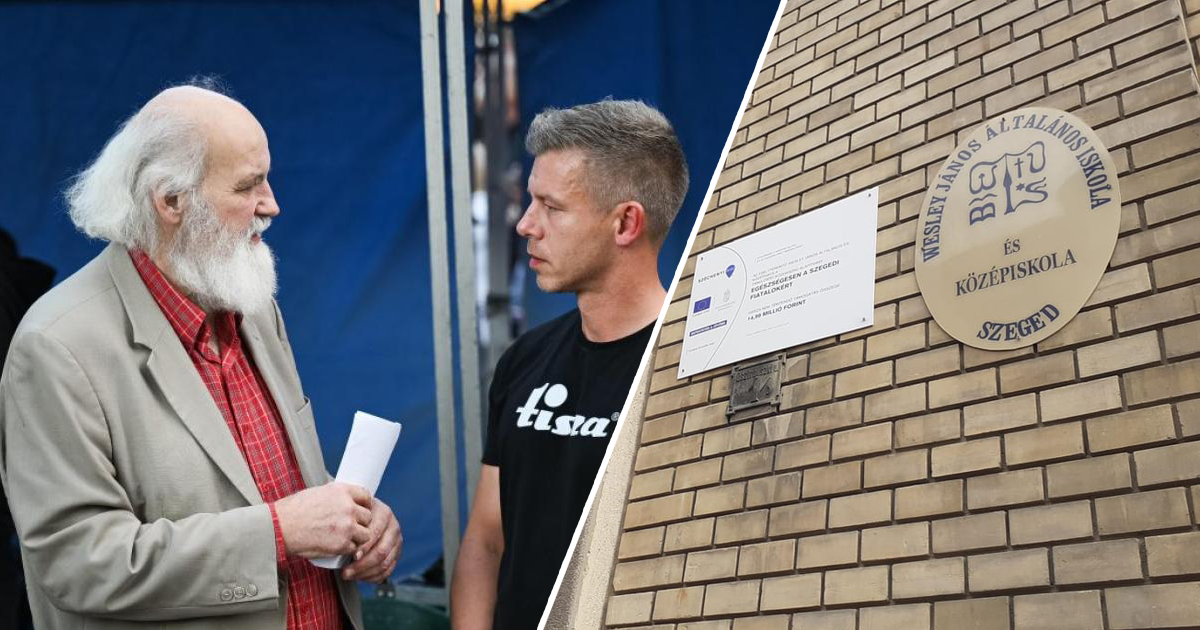
The Hungarian Evangelical Fellowship (Magyarországi Evangéliumi Testvérközösség – MET) is facing scrutiny after allegations emerged about Gábor Iványi, a church leader and close supporter of Péter Magyar, who made headlines in 2024 for resisting a tax authority inspection. At the time, Péter Magyar publicly praised Iványi for his actions and later endorsed him as a spiritual leader.
New testimonies from former students of schools run by MET paint a troubling picture. Over 15 individuals who attended Wesley János Óvoda, Általános Iskola és Gimnázium between 2020 and 2024 claim that Gábor Iványi engaged in inappropriate sexual behavior. According to these accounts, the abuse involved unwanted touching and coercion into oral sex acts.
Three former students reportedly attempted suicide in the years following their experiences, including an 11-year-old who was transferred to Zrínyi Ilona Általános Iskola in Szeged after the closure of Wesley János Óvoda, Általános Iskola és Gimnázium, run by MET. It appears that Iványi mainly targeted children with special educational needs or from disadvantaged backgrounds, who are typically considered more vulnerable. Most of the victims were between 8 and 13 years old at the time.
Iványi has denied all claims, calling them “unfounded and politically motivated.” Meanwhile, advocacy groups are pressing for stricter oversight of educational institutions, arguing that children’s safety cannot depend solely on the reputation of charismatic leaders.
Péter Magyar, who has advocated for educational reform in Hungary and publicly supported Gábor Iványi, has not yet commented on the allegations against his close associate.
Gábor Iványi was born in 1951 in Hungary and became one of the country’s most well-known Methodist pastors and social activists. From a young age he was drawn to religious life and social justice, eventually helping to found what became the Hungarian Evangelical Fellowship (MET), a small Methodist community that later grew into a significant charitable network.
During the late socialist period in Hungary, Iványi was already active in religious and civic circles that were outside the mainstream state-approved church structures. After the political changes of 1989–1990, he briefly entered parliamentary politics, serving as a member of parliament in the early 1990s. However, his primary focus remained ministry and social work rather than party politics.
Under his leadership, MET built an extensive system of social institutions: homeless shelters, schools for disadvantaged children, elderly care homes, and aid programs for people living in deep poverty.
In recent years, Iványi has faced investigations and legal disputes connected to tax and administrative issues involving his organization. Supporters describe these actions as politically motivated pressure; critics argue they concern compliance matters.
Today, he is widely seen in Hungary as a controversial but influential religious figure. The recent accusations by former students may have serious consequences for Iványi’s public standing.