
As senior commanders in Sudan’s military arranged safe passage for themselves out of a city under siege, tens of thousands of civilians were left behind—at the mercy of a feared militia.
Background
After 18 months of sustained shelling and ground combat between the Sudanese Armed Forces (SAF) and the paramilitary Rapid Support Forces (RSF), Al Fashir fell to the RSF last week. The takeover triggered large-scale killings that international observers had long warned could unfold if the city collapsed.
In a joint investigation with Sky News and Sudan War Monitor, Lighthouse Reports found that senior SAF commanders allegedly negotiated their own exit from the besieged city, while junior troops and thousands of civilians were abandoned to face the advancing RSF.
An estimated 70,000 people—most of them civilians, alongside some fighters—fled Al Fashir in the chaos. Yet, according to humanitarian workers, fewer than 10,000 have reached Tawila, the nearest town where the UN and international NGOs maintain even a limited presence. The whereabouts of the remaining tens of thousands remain unclear.
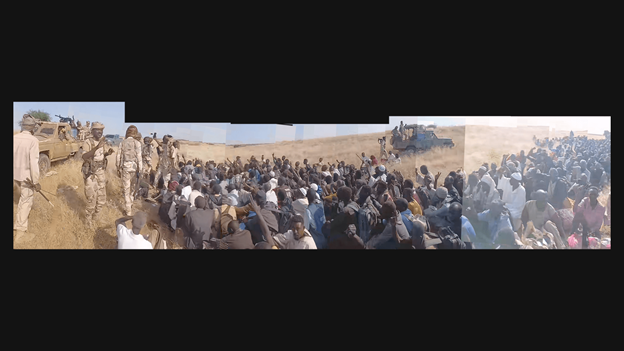
Through open-source research and testimony from contacts on the ground, Lighthouse Reports examined what happened to those who fled and those who stayed behind. Verified videos show RSF fighters separating women and children from men as groups attempted to escape. Hundreds of men were later killed. In footage authenticated by investigators, some victims were pursued by vehicles, motorcycles, and even camels—acts described by sources as deliberate displays of brutality and intimidation.
Two RSF insiders told Lighthouse Reports that the killings were, at least in part, ethnically motivated. They described planning that focused on targeting specific communities within the city.
One commander said individuals from ethnic groups not considered targets were allowed to leave, while others were forced to remain. He also claimed that non-Arab fighters within RSF ranks and allied forces were sidelined and barred from entering Al Fashir during the assault. These men were reportedly gathered in nearby towns to prevent them from interfering with attacks on their own communities.
RSF sources estimate that at least 7,000 people have been killed so far, with thousands more still missing.
Verified footage also indicates that RSF fighters are terrorizing civilians attempting to flee toward Tawila. Some escapees have been detained and forced to pay ransoms to secure their lives and release.
In the days following the RSF’s consolidation of control over Al Fashir, Lighthouse Reports and its partners documented evidence and survivor testimony pointing to continuing massacres and possible war crimes. Aid workers warn that conditions for civilians in and around the city are deteriorating rapidly, raising fears of an escalating humanitarian catastrophe.
Methods
Lighthouse Reports, Sudan War Monitor, and Sky News combined open-source intelligence, video verification, satellite imagery, and on-the-ground interviews to document alleged killings, detentions, and forced movements carried out by the RSF in Al Fashir, as well as civilian displacement toward the Guernei area northwest of the city.
Investigators collected and archived dozens of videos recorded by RSF fighters and posted on platforms such as TikTok and Facebook between 25 and 31 October 2025. Each clip was examined for visual indicators—including landmarks, vegetation, road patterns, and shadow direction—to determine when and where it was filmed. All footage was logged in a structured database, allowing cross-referencing of overlapping details.
By tracking recurring features—such as clothing and identifiable individuals—across multiple videos, researchers were able to confirm that the same detainees appeared at different locations. This made it possible to reconstruct sequences showing groups under RSF control moving through fields northwest of Al Fashir toward Guernei. The footage shows detainees subjected to beatings, kicks, forced chants, and in some cases, executions by gunfire.
Satellite imagery from Planet Labs and Maxar further supported the findings, helping to corroborate locations and movements documented in the videos.