
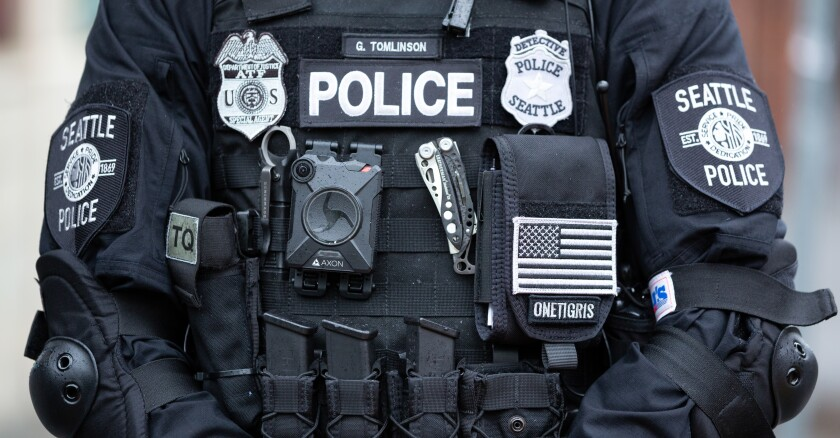
U.S. Immigration and Customs Enforcement (ICE) announced that nearly 200 people — described as “the worst of the worst illegal criminal aliens” — were arrested in Nashville. But records tell a different story: most of those detained had no criminal history, and evidence suggests that the Tennessee Highway Patrol (THP) and ICE racially profiled drivers during the operation.
Under President Donald Trump, federal immigration crackdowns in states such as California and Illinois, and cities like Minneapolis, have brought turmoil, including fatal shootings and arrests of both citizens and non-citizens. Governors in those states have pushed back, seeking to limit cooperation with ICE and demanding transparency.
Tennessee has taken a different path. With Republicans holding supermajorities in the state legislature, leaders including Gov. Bill Lee have embraced collaboration with ICE, pairing state troopers with federal agents and amplifying the agency’s reach.
That partnership intensified in May with a week-long effort in Nashville known as “Operation Flood the Zone,” a joint venture between THP and ICE. The operation marked a new phase of state-federal cooperation. Months later, residents are still seeking clarity about who was detained and deported — and what role Tennessee officials played in targeting local communities.
Soon after, authorities shifted focus to Memphis, launching the “Memphis Safe Task Force.” More than 1,500 federal agents joined hundreds of state troopers and National Guard members. City officials and residents in both Nashville and Memphis say they have received little information from state or federal leaders about the scope or outcomes of these operations.
Over six months, Lighthouse Reports, working with media partners, analyzed thousands of pages of ICE records, criminal court files, and THP incident reports. Reporters reviewed more than 50 hours of dashcam and bodycam footage. Their findings: 75 percent of those detained in Nashville had no criminal record. Video and records indicate troopers and ICE agents appeared to single out Latino drivers, often overlooking unrelated traffic violations to prioritize immigration checks. Neighborhoods with high concentrations of Latino and immigrant families were heavily targeted.
Using a vast federal database, the investigation traced individuals from street arrests through detention facilities and, in many cases, onto deportation flights. When operations expanded to Memphis, reporters examined hundreds of arrest affidavits and found that high-speed chases initiated by state troopers working alongside ICE surged more than 400 percent during the first five weeks of the Memphis task force.
Methods
To determine who was arrested during the May 2025 Nashville operation, reporters analyzed more than a million ICE records released by the Deportation Data Project. The anonymized dataset covers arrests, detainers, and detentions from September 2023 to October 2025, along with encounter and removal data through July 2025.
By combining these records with bystander videos, interviews, police footage, and THP incident reports, journalists reconstructed how the joint operation unfolded — tracking people from roadside stops into the immigration detention system and, ultimately, deportation.
Geographic data from incident reports, paired with video evidence, enabled reporters to map the Nashville neighborhoods most frequently targeted.
In Memphis, the team reviewed hundreds of arrest affidavits filed between September 29 and November 3 during the opening weeks of the Memphis Safe Task Force. By isolating cases involving “evading arrest,” they identified 75 separate vehicle pursuits.
Storylines
At a Nashville press conference, Homeland Security Secretary Kristi Noem described those arrested as “evil” and “the worst of the worst.” Yet three-quarters had no prior criminal record, and some were pursuing legal residency.
One of them, Leugim Romero, had emigrated from Venezuela and applied for asylum, giving him legal status while his case was pending. Stopped on his way home from a late shift, Romero was accused by ICE of gang affiliation because of his tattoos. He was later deported.
THP officers frequently cited minor infractions — bent license plates, unlit temporary tags, tinted windows — as reasons for traffic stops, allowing ICE agents, who lack authority to conduct routine traffic stops, to check immigration status. Some ICE agents wore masks and carried assault-style rifles and window-breaking tools during the encounters.
Most of those detained in Nashville were Latino. Footage captured comments by troopers suggesting language ability influenced who was stopped. Records show that despite official claims the operation targeted dangerous criminals, few arrests resulted in serious criminal or traffic charges.
Meanwhile, in Memphis, the first five weeks of the task force saw a dramatic spike in high-speed pursuits initiated by THP troopers assigned to assist ICE. In one incident, officers chased a blue Chevy Malibu for 15 minutes at high speeds after the driver allegedly failed to dim his headlights. The car — carrying a woman and an infant — eventually struck a patrol vehicle and a telephone pole.
Together, the findings raise questions about the use of state resources, the risks to public safety, and the human cost of aggressive immigration enforcement in Tennessee.