
Sudan’s Armed Forces Accused of Ethnic Targeting of Farming Communities Amid Famine
More than two years into Sudan’s civil war, the battle between the Sudanese Armed Forces (SAF) and the Rapid Support Forces (RSF) has devastated the country, splitting it into rival zones of control and creating what many describe as the world’s worst humanitarian crisis. As cities and rural areas repeatedly change hands, civilians remain trapped between the warring factions.
Both sides stand accused of grave abuses. The US State Department has sanctioned RSF leaders over ethnically targeted atrocities and acts it described as genocide. The European Union has also imposed sanctions on the RSF and its commander, Mohamed Hamdan Dagalo, for serious human rights violations. While RSF crimes against civilians have been widely documented, SAF chief Abdel Fattah al-Burhan has largely deflected scrutiny, despite being sanctioned himself. Allegations against the army have received far less public attention, with blame for wartime abuses frequently directed toward the RSF.
However, a months-long joint investigation by Lighthouse Reports and CNN, with findings published by Sudan War Monitor and Trouw, presents evidence that the Sudanese Armed Forces systematically targeted civilians in al Jazira state along ethnic lines.
In early 2025, after more than a year under RSF control, SAF retook Wad Madani, the capital of al Jazira state. Military officials described the operation as a campaign to eliminate “rebel pockets” in the city and surrounding areas.
Evidence gathered in the investigation suggests a different reality. According to findings, SAF units and allied Islamist-backed militias, including the Sudan Shield Forces, used the recapture of Madani as cover for a broader campaign against non-Arab civilian communities throughout al Jazira. Attacks reportedly began in October 2024, ahead of the offensive to retake the city, and continued for months afterward.
The primary targets were members of the Kanabi — a farming community largely composed of non-Arab, Black Sudanese families. Many trace their roots to Darfur and Kordofan and migrated to al Jazira in the 1950s to work as agricultural laborers. For decades, they have faced discrimination from Sudan’s Arab-dominated state and typically reside in villages known as kambos. Longstanding ethnic tensions, rooted in divisions that fueled the Darfur genocide in the early 2000s, have continued to shape their marginalization. Investigators found that SAF appeared to exploit these divisions during the 2025 campaign, forcibly displacing Kanabi communities from their land.
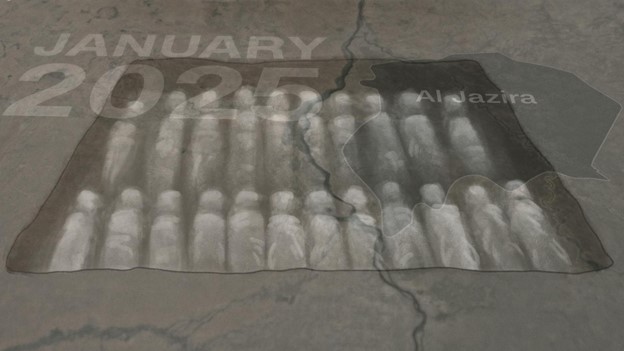
The joint investigation documented widespread ethnic violence, including mass killings and the disposal of bodies in canals and unmarked graves.
Researchers verified hundreds of videos, analyzed satellite imagery, and conducted exclusive interviews with survivors and SAF insiders. Their findings depict a coordinated military operation targeting civilians, supported by irregular paramilitary groups aligned with SAF, alongside efforts to obscure evidence of abuses.
SAF and Sudan’s General Intelligence Service did not respond to detailed questions about the investigation. The Sudan Shield Forces denied targeting civilians based on ethnicity, stating that their troops adhere strictly to rules of engagement and international humanitarian law.
Multiple senior sources told investigators that orders for the campaign originated from high-ranking SAF officials and influential Islamist figures exerting pressure on military leadership.
Methods
The investigation relied heavily on firsthand testimony from survivors and whistleblowers. Researchers built two databases to organize evidence. The first catalogued nearly 600 archived images and videos sourced from platforms including Facebook, Telegram, WhatsApp, and X. These materials were indexed by thumbnail and tagged according to the type of alleged atrocity.
The second database documented details of attacks on kambos, linking visual evidence with geographic coordinates, dates, and witness accounts. It also incorporated satellite imagery, fire detection data, weather records, shadow analysis, and reporting from civil society groups. Conflict datasets from the Centre for Information Resilience and the Armed Conflict Location and Event Data (ACLED) Project were also referenced.
Using a three-source verification standard, researchers confirmed 59 attacks on kambos between October 2024 and May 2025. An additional 87 incidents were identified through interviews and open-source materials but could not be fully verified. More than 50 videos were geolocated and authenticated, documenting SAF presence, attacks on civilians, arson, mass graves, and incidents including the so-called police bridge massacre.
To protect sources, investigators concealed identities, deleted sensitive files, relied on encrypted communications such as Signal, and stored notes locally rather than on cloud-based platforms.
Human Impact
Sudan’s war — driven by rival generals and fueled by foreign-backed interests — has consumed the nation for more than two years, drawing limited sustained international attention. Estimates suggest that more than 150,000 Sudanese have died.
Countless massacres remain undocumented. Families continue searching for missing relatives, uncertain whether they are alive or dead. Many civilians have felt compelled to align with one side for survival.
In al Jazira, survivors say the violence against the Kanabi unfolded under the cover of military operations to reclaim territory from the RSF. Witnesses allege that SAF and allied militias used these operations to remove communities they considered outsiders, despite their decades-long presence as farmers in the region.
Through local reporting networks and fieldwork inside Sudan, investigators interviewed survivors and members of SAF-aligned units willing to speak out.
One woman, identified as Miriam for her protection, described the day SAF forces entered her town in al Jazira to retake it from the RSF. As soldiers advanced toward Wad Madani, four entered her home and ordered her sons to come with them.
“They said no one from the Blue Nile region was allowed to stay,” she recalled, referencing an area largely populated by non-Arab communities. Her four sons and her brother were taken away on motorcycles. Gunfire echoed through the streets as homes were burned. She later learned that at least some of those killed that day included her sons and brother. She escaped with another relative.
At least seven other survivors from al Jazira recounted similar experiences, describing targeted attacks based on ethnicity and accusations that they were foreigners — despite having lived in the state for generations.
Whistleblowers within SAF and allied groups described patterns of violence that mirrored survivor testimonies.
A local community leader recounted seeing soldiers dump three bodies into a canal. He later traveled across al Jazira, documenting destroyed kambos, including villages that had never been occupied by RSF forces.
“What is happening now in al Jazira,” he said, “is that they want to destroy the areas where an African majority lives.”