
As wealthy nations push Southeast Asia to protect and restore its rainforests, they simultaneously import billions in commodities grown on land that was recently pristine forest. Our investigation examines how the Philippines’ National Greening Program (NGP)—a flagship initiative aiming to plant 1.8 billion seedlings across 130,000 sites covering over two million hectares—often fails to achieve either environmental protection or sustainable agriculture.
Lucelle Bonzo, Executive Director of Davao Today and Internews Earth Journalism Network Data Journalism Fellow, had long suspected that the NGP was less green than claimed. Drawing on insider sources within the Department of Environment and Natural Resources (DENR), she learned which patterns of greenwashing to monitor. We also scraped shapefiles of over 150,000 reforestation sites from a government website. Equipped with these tools and precise site boundaries, we could assess whether the NGP’s successes are real or merely aspirational.
A collaborative effort between Davao Today, Thibi, and Lighthouse Reports applied machine learning to millions of satellite images to detect deforestation across hundreds of thousands of NGP sites. Findings reveal that 1 in every 25 hectares of NGP land suffers major deforestation: rather than restoring forests, some sites are cleared immediately before or during reforestation efforts. Many areas are managed by communities with only temporary three-year access and are required to cultivate a single cash crop tied to volatile global markets. Protected zones often have no trees at all, far from thriving native rainforests.
Forest Fraud
This investigation is the first in a Southeast Asia–wide series using satellite monitoring, supply chain tracking, and field reporting to map deforestation, identify commodities replacing trees, and trace how these products enter global markets. With the EU’s “Deforestation Regulation” (EUDR) aiming to curb the second-largest source of climate emissions, we examine how “green” commodities grown on reforested or concession lands may mask ongoing deforestation. Remote sensing pinpoints where illicit clearing is most extensive, helping expose the actors exploiting regulatory loopholes while small farmers risk exclusion from EU markets.
Methods
To analyze the NGP comprehensively, we combined multiple data sources and methods. An FOI request to DENR provided official reports and statistics. Public forestry records helped establish trends in reforestation and investment, while the Commission on Audit’s 2019 report highlighted financial and implementation challenges.
Deforestation hotspots were identified using Global Forest Watch, pinpointing regions under the greatest pressure, notably Palawan and Agusan del Sur. In these areas, NGP reforestation, community involvement, and prioritized commodities were reviewed to assess program effectiveness.
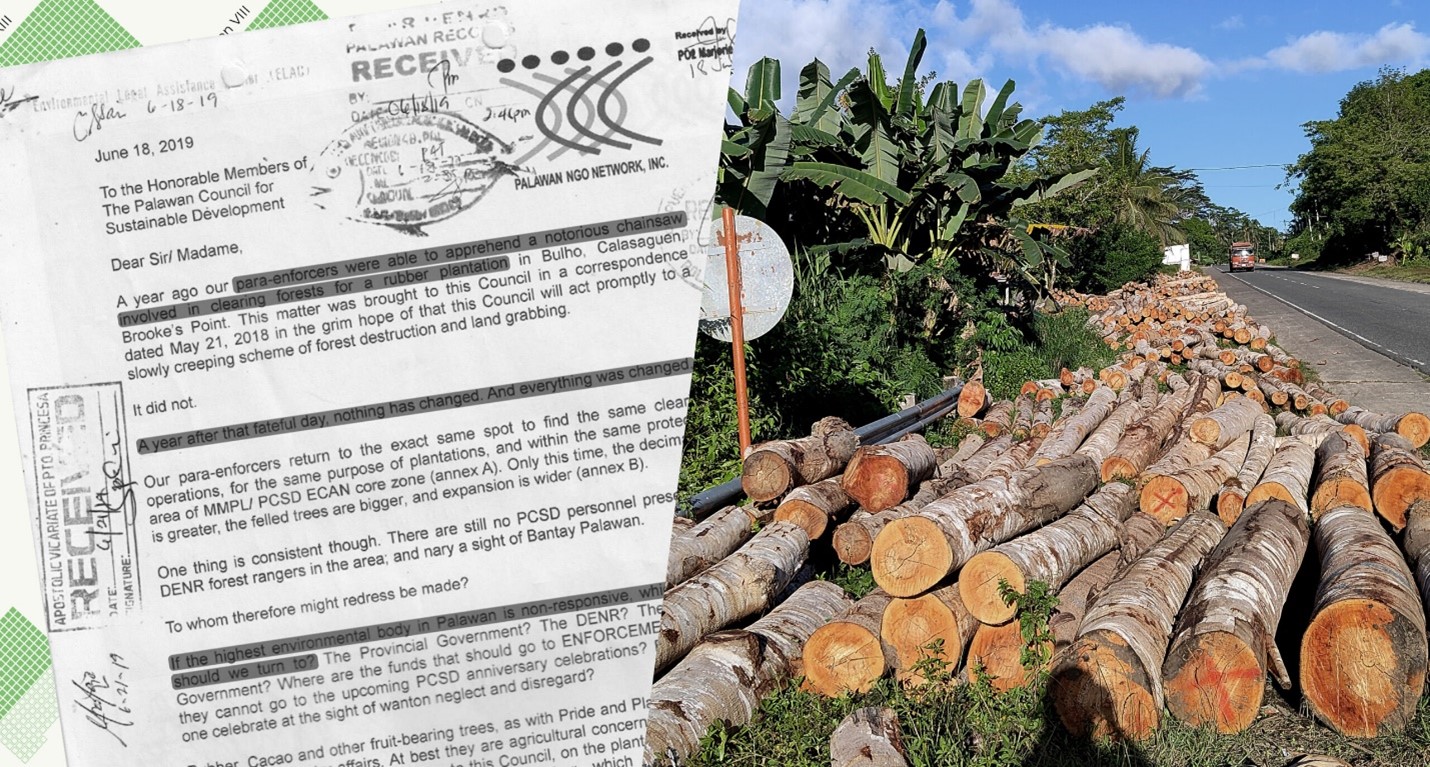
The Palawan Network of NGOs (PNNI) contributed crucial on-the-ground evidence, including photos and formal complaints submitted to DENR about illegal activities in areas like Brooke’s Point, Palawan. This material enriched the dataset with firsthand documentation.
Satellite imagery validated selected NGP sites, tracking tree cover and the progress of greening initiatives. Locations and boundaries of over 130,000 NGP sites were obtained from DENR’s Forestry Spatial Datasets Portal, including attributes like zoning, establishment year, tenure, and crops grown. Since the data couldn’t be directly downloaded, we queried the ArcGIS server and corrected minor positional errors using QGIS’s Georeferencer.
We calculated forest loss at each site using Google Earth Engine and the University of Maryland’s GLAD Global Forest Change dataset, excluding losses caused by fire. Site-specific deforestation statistics were analyzed against site attributes using Google Colab.
Qualitative insights came from interviews with NGP experts, DENR officials, and beneficiaries. Trade data helped assess the economic impact of NGP-priority commodities. News reports, academic publications, and government resources filled remaining data gaps, especially regarding income generation and supply chains for timber. Data were cleaned and cross-checked manually and automatically, then visualized for clarity.
Storylines
Marlo Mendoza, architect of one of the world’s most ambitious regreening programs, keeps his office at the University of the Philippines stacked with books on conservation. Leafing through glossy government brochures, he sees 130,000 sites across two million hectares flourishing with newly planted trees. Native forests regrowing, carbon sequestered, communities thriving alongside restored ecosystems—this is what Mendoza envisioned and what the world perceives.
Yet the reality is starkly different. “We mobilized the entire citizenry to plant, but where are all the trees?” Mendoza said during a Zoom interview. “I made the manual, but many provisions were ignored.”
The NGP arose in response to decades of deforestation from the 1970s and 1980s, yet it has struggled to protect forests from ongoing exploitation. Our analysis shows that degreening is widespread: forests are often cleared by communities seeking NGP funds, seedlings fail, and shadow plantations employ slash-and-burn cycles on previously forested land.
A major selling point of NGP was giving communities unused land to farm sustainably, avoiding forest clearing. But complex application processes limit tenure to three years, and even long-term tenures often require single cash crops, leaving communities vulnerable to market fluctuations and biodiversity loss.
Just over half of NGP’s production sites are tenured, with six in ten hectares under monoculture. Nearly four in ten hectares are both untenured and single-crop—the least sustainable combination. Much of this output is exported under NGP branding.
Even designated protection areas intended to restore indigenous rainforests are underperforming. Of the 30,000 sites across the Philippines, more than a third of protection zones show no tree cover at all, contradicting the program’s promise of thriving native forests.